Smart Contract migration
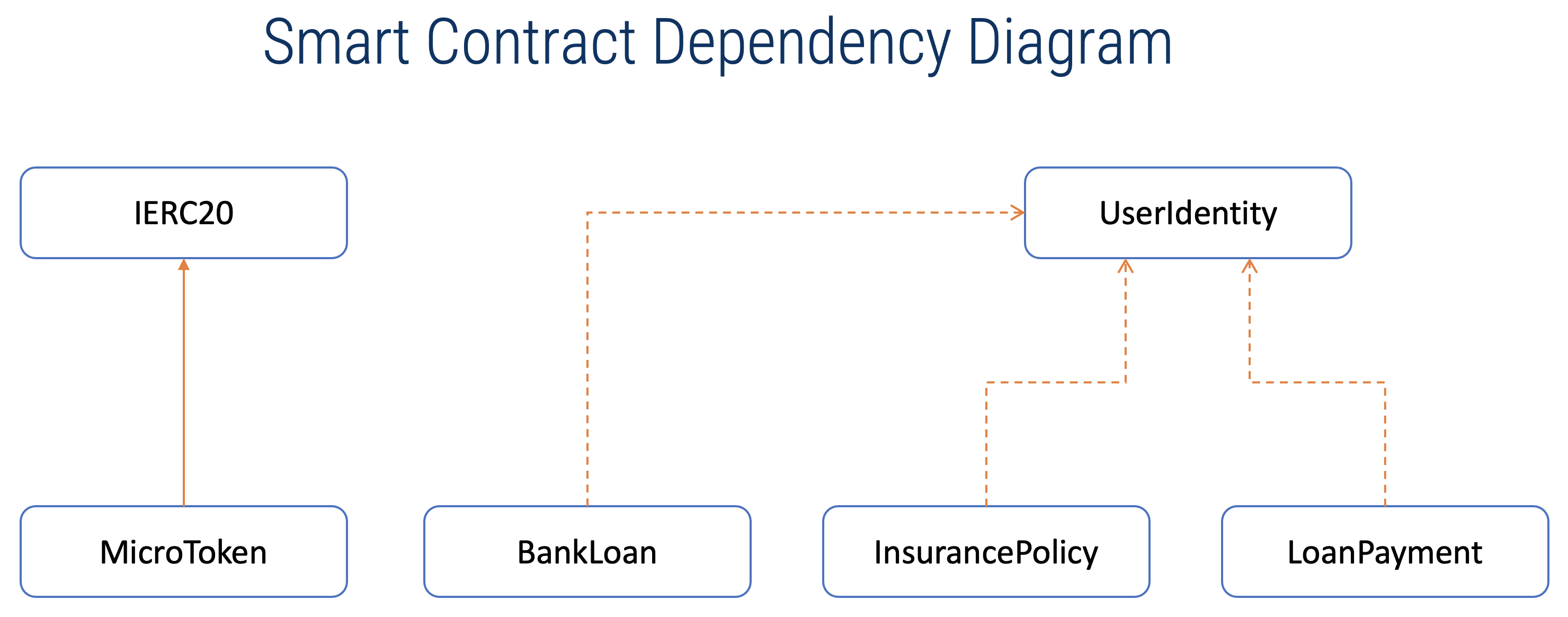
Smart contract dependency diagram
The following diagram shows the dependency between smart contracts.
MicroToken smart contract implements the ERC20 Token Interface(IERC20).
UserIdentity smart contract stores the stake holders’ details.
BankLoan, InsurancePolicy, LoanPayment smart contracts uses UserIdentity smart contract to verify the users.
migration
Initial migration
Truffle uses a Migrations contract in order to help manage the migrations feature. This contract must contain a specific interface, but you’re free to edit this contract at will. For most projects, this contract will be deployed initially as the first migration and won’t be updated again. You will also receive this contract by default when creating a new project with truffle init.
Filename: contracts/Migrations.sol
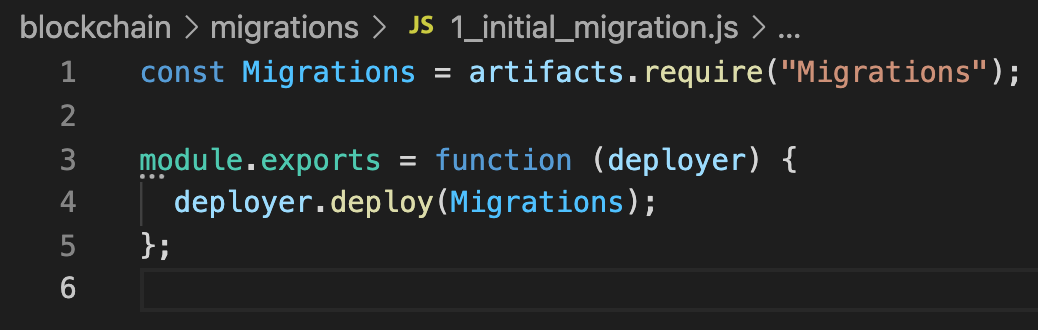
You must deploy this contract inside your first migration in order to take advantage of the migrations feature. The following migration is provided by default when creating a new project with truffle init:
Filename: migrations/1_initial_migration.js
You can find more details in Truffle Running Migration Page.
Micro Token Smart Contract Migration
The migration code for the MicroToken smart contract.
const MicroToken = artifacts.require("MicroToken");

module.exports = function(deployer) {
    deployer.deploy(MicroToken);
};
Filename: migrations/2_micro_token_migration.js
At the beginning of the migration, we tell Truffle we’d like to interact with MicroToken via the artifacts.require() method.
The name specified should match the name of the contract definition within that source file.
Do not pass the name of the source file, as files can contain more than one contract.
Then we can use deployer.deploy method to deploy the MicroToken smart contract.
User Identity and other Smart Contract Migration
We use following code to deploy UserIdentity and other smart contracts.
const UserIdentity = artifacts.require("UserIdentity");
const BankLoan = artifacts.require("BankLoan");
const InsurancePolicy = artifacts.require("InsurancePolicy");
const LoanPayment = artifacts.require("LoanPayment")

module.exports = async function(deployer, network, accounts)
{
    await deployer.deploy(UserIdentity);
    const userIdentityInstance = await UserIdentity.deployed();

    await deployer.deploy(BankLoan, userIdentityInstance.address);
    await deployer.deploy(InsurancePolicy, userIdentityInstance.address, {from: accounts[1]});
    await deployer.deploy(LoanPayment, userIdentityInstance.address);
};
Filename: migrations/3_user_identity_migration.js
As describe in above migration, first we insert all the contracts we’d like to interact with
(UserIdentity, BankLoan, InsurancePolicy, LoanPayment).
As shown in the above Smart Contract Dependency Diagram BankLoan, InsurancePolicy and LoanPayment smart contracts
need UserIdentity smart contract address to deploy.
To achieve this first we deploy the UserIdentity smart contract.
We use async/await methods to deploy these contracts.
After deploying the UserIdentity smart contract we wait for it finishes the deployment.
Then we deploy other three smart contract with UserIdentity smart contract address as a parameter.
Bank is the owner of UserIdentity, BankLoan, and LoanPayment smart contracts.
But for the InsurancePolicy smart contract Insurance Company is the owner.
To fullfill this requirement we deploy InsurancePolicy smart contract with a different account.
We can define optional parameters as the third argument for the deployer.deploy function.
We specify the second account of the accounts array as the dployer account for the InsurancePolicy smart contract.
If not specify the deployer account it will take the first account as the deployer account.