Smart Contracts
This project has three smart contracts.
They reside in the contracts directory.
Microfinance
    |--blockchain
    |  |--contracts
    |  |  |--BankLoan.sol
    |  |  |--MicroToken.sol
    |  |  |--Migrations.sol
    |  |  |--UserIdentity.sol
    |  |--migrations
    |  |--test
    |  |--truffle-config.js
1. Micro Token Smart Contract - MicroToken.sol
This smart contract handles the ERC20 token in the system. ERC20 is a technical standard used for smart contracts on the Ethereum blockchain for implementing tokens. It defines a common list of rules and constraints that an Ethereum token has to implement, giving developers a standard pattern to program how new tokens will function within the Ethereum ecosystem. All ERC20 token-related information such as token name, total supply, and functionalities like transfer tokens, account balances, are handled through this contract. More information here.
The MicroToken smart contract implements the IERC20 smart contract interface.
Attributes
The MicroToken smart contract has these token related attributes:
string public constant symbol = "MFT";
string public constant name = "Microfinance Token";
uint8 public constant decimals = 0;
uint private constant __totalSupply = 1000;
mapping (address => uint) private __balanceOf;
mapping (address => mapping (address => uint)) private __allowances;
symbol: Symbol of the ERC20. This symbol will show in wallets and other places.name: Name of the token. In this project, our token name isMicrofinance Token (MFT).decimals: This attribute configures the number of decimal places we use in our token. We set it to 0 as we don’t use decimal values.__totalSupply: This attribute holds the total number of tokens in circulation in the system.__balanceOf: This mapping contains the token balance of each account holder.__allowances: Account owner may grant permission to another account to do the token transfers on behalf of him. But owner can grant permission for limited token amount only. This mapping holds the number of tokens allowed to transfer from one account to another by third party account.
Constructor
The following code segment is the constructor of the MicroToken smart contract:
constructor() {
        __balanceOf[msg.sender] = __totalSupply;
}
It assigns all the tokens (__totalSupply) to the smart contract deployer’s (msg.sender) account, which in the Microfinance system is the Bank. The Bank owns all the tokens. So the Bank account (in MetaMask/blockchain) should deploy this smart contract to assume ownership.
Functions
We discuss the various things the MicroToken smart contract should do.
Since MicroToken.sol contract implements the IERC20 interface form OpenZeppelin, you can find more about these functions
from the github IERC20 repo.
totalSupply
Return the __totalSupply of Tokens. It is a public function:
function totalSupply() public pure override returns (uint _totalSupply) {
    _totalSupply = __totalSupply;
}
balanceOf
Return token balance of a given account. An account address should be passed as a parameter to this function. It is a public function:
function balanceOf(address _addr) public view override returns (uint balance) {
    return __balanceOf[_addr];
}
transfer
Transfer tokens from one account to another. Tokens are transferred from the caller’s (msg.sender) account. _to is the receiving account and ``_value `` is the token amount.
This function returns true if transfer is successful and false otherwise.
function transfer(address _to, uint _value) public override returns (bool success) {
    if (_value > 0 && _value <= balanceOf(msg.sender)) {
        __balanceOf[msg.sender] -= _value;
        __balanceOf[_to] += _value;
        return true;
    }
    return false;
}
transferFrom
Transfer tokens from one account to another via a third-party account.
Token owner is the _from parameter; the receiver’s account is _to parameter. The function caller is the spender. Token amount is the _value parameter.
Note the various conditions it checks before performing the transfer.
It returns true if successful or false otherwise.
function transferFrom(address _from, address _to, uint _value) public override returns (bool success) {
    if (__allowances[_from][msg.sender] > 0 &&
        _value > 0 &&
        __allowances[_from][msg.sender] >= _value &&
        __balanceOf[_from] >= _value) {
        __balanceOf[_from] -= _value;
        __balanceOf[_to] += _value;
            __allowances[_from][msg.sender] -= _value;
        return true;
    }
    return false;
}
approve
An owner may grant permission to a spender to transfer tokens from his account. The transfer is materialized by the transferFrom function above.
To grant permission, the owner should approve the _spender’s account address and the token _value.
This function returns true if it is successful.
function approve(address _spender, uint _value) public override returns (bool success) {
    __allowances[msg.sender][_spender] = _value;
    return true;
}
allowance
It informs the amount of tokens the _owner has granted the _spender to spend.
function allowance(address _owner, address _spender) public view override returns (uint remaining) {
        return __allowances[_owner][_spender];
}
2. User Identity Smart contract - UserIdentity.sol
This contract holds User details. It registers Broker and Borrower details.
enum
We capture different roles of users in the system using enum. Currently there are 3 user roles in the system.
enum Role { GUEST, BROKER, BORROWER }
struct
User - This struct holds user attributes.
struct User{
    uint id;
    string socialSecurityId; // each property has an unique social security id
    address walletAddress;
    string name;
    Role role;
}
id- System assigned id for the user. This is an incremental number.socialSecurityId- Social security number.walletAddress- User wallet account address (from Ganache or other blockchain).name- User name.role- User role (BROKER, BORROWER).
Modifiers
The following modifiers are used in the UserIdentity.sol functions.
isAdmin()- Check whether function caller is the admin (creator and deployer) of the contract.
Attributes
UserIdentity.sol has the following attributes.
admin- Deployer account address of the smart contract.brokersCount- Total number of brokers in the system.borrowersCount- Total number of borrowers in the system.borrowers- List of Borrowers in the system (address-to-User mapping).brokers- List of Brokers in the system (address-to-User mapping).brokersAddresses- List of Broker addresses (dynamic array).borrowersAddresses- List of Borrower addresses (dynamic array).
Constructor
The constructor designates the contract deployer (msg.sender) as the admin.
constructor()
{
    admin = msg.sender;
}
Functions
addBroker
Add new Broker account to the system:
function addBroker(string memory _socialSecurityId, address _address, string memory _name)
    public isAdmin()
- Parameters:
_socialSecurityId- Social Security ID of Broker._address- Wallet account address of Broker._name- Broker’s name.
- Modifiers:
isAdmin()- Check whether function caller is the admin of the smart contract instance.
addBorrower
Add new Borrower account to the system:
function addBorrower(string memory _socialSecurityId, address _address, string memory _name)
    public isAdmin()
- Parameters:
_socialSecurityId- Social Security ID of Broker._address- Wallet account address of Borrower._name- Borrower’s name.
- Modifiers:
isAdmin()- Check whether function caller is the sdmin of the smart contract instance.
verifyIsBroker
Verify whether the given account address is a Broker account or not.
function verifyIsBroker(address _address) public view returns(bool)
- Parameters:
_address- Account address of user.
This function is used by other smart contracts to verify a Broker account.
It returns true if the broker exists on the given address or false otherwise.
verifyIsBorrower
Verify whether the given account address is a Borrower account or not.
function verifyIsBorrower(address _address) public view returns(bool)
- Parameters:
_address- Account address of user.
This function is used by other smart contracts to verify a Borrower account.
It returns true if the Borrower exists on the given address or false otherwise.
getAllBrokers
Return all the Brokers as an array.
function getAllBrokers() public view returns (User[] memory)
- Return:
User []- List of Brokers as an array.
getAllBorrowers
Return all the Borrowers as an array.
function getAllBorrowers() public view returns (User[] memory)
- Return:
User []- List of Borrowers as an array.
3. Bank Loan Smart Contract - BankLoan.sol
This smart contract stores Bank Loan details. The Bank is the owner of this smart contract.
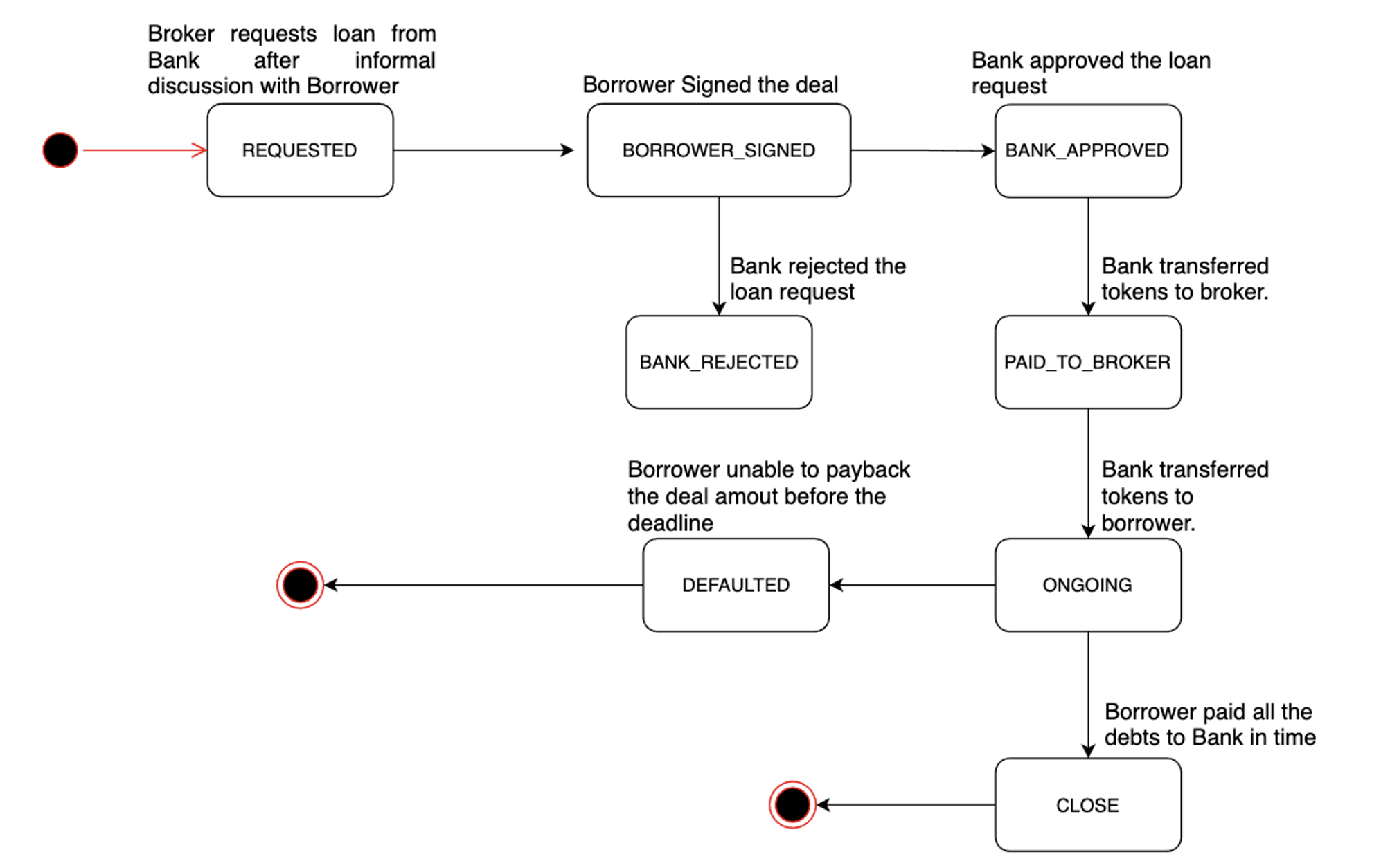
State Transition Diagram of The Bank Loan
The following diagram shows the state transition of a Bank Loan.
We use this state transition diagram to implement Bank Loan state changes in the BankLoan smart contract.
enum
LoanState - This enum holds individual loan states. There are 14 loan states.
enum LoanState{
    REQUESTED,
    BORROWER_SIGNED,
    BANK_APPROVED,
    BANK_REJECTED,
    PAID_TO_BROKER,
    ONGOING,
    DEFAULT,
    CLOSE
}
REQUESTED- Initial state of a loan. Broker requests a loan on behalf of a Borrower.BORROWER_SIGNED- Borrower agrees to the Loan.BANK_APPROVED- Bank approves the LoanBANK_REJECTED- Bank rejects the LoanPAID_TO_BROKER- Bank gives fee to Broker.ONGOING- Bank transfers tokens to the Borrower’s account.DEFAULT- Borrower is unable to pay back the Loan.CLOSE- Borrower paid back the Loan.
struct
Loan - This structure holds Loan attributes.
struct Loan{
    uint id;
    uint amount;
    uint months;
    uint interest;
    string planId;
    LoanState state;
    address broker;
    address borrower;
    uint brokerFee;
    bool bankApprove;
    bool isBorrowerSigned;
}
id- Loan Id.amount- Loan amount.months- Loan duration in months.interest- Loan interest.planId- Loan plan Id.state- Current state of the loan.broker- Address of the Broker who applied the Loan.borrower- Borrower address of the loan.brokerFee- Broker fee for the Loan.bankApprove- Status of the Bank approval for the Loan.isBorrowerSigned- Borrower Signed status.
Event
This event is defined in the BankLoan smart contract.
loanRequest
This event is emitted when a Broker creates a loan request.
event loanRequest(
    uint id,
    uint amount,
    uint months,
    uint interest,
    string planId,
    LoanState state,
    address broker,
    address borrower,
    uint brokerFee,
    bool bankApprove,
    bool isBorrowerSigned
);
- Parameters:
id- Loan Id.amount- Loan amount.months- Duration of the loan.interest- Loan interest.planId- Loan plan Id.state- Current state of the loan.broker- Broker of the loan.borrower- Borrower address of the loan.brokerFee- Broker fee for the Loan.bankApprove- Bank approval status.isBorrowerSigned- Borrower signed status.
Modifiers
The following modifiers are used in the BankLoan.sol functions.
isAdmin()- Check whether function caller is the owner of the smart contract.isBroker()- Check whether function caller is registered as a Broker in the system.isBorrower(address _address)- Check whether given_addressis registered as a Borrower in the system.isLoanBorrower(uint _loanId)- Check whether function caller is the Borrower of a given Loan.isValidLoan(uint _loanId)- Check whether Loan exist in the system.isLoanIn(uint _loanId, LoanState _state)- Check whether given Loan is in specific Loan State.
Attributes
UserIdentity: identitySC- Stores UserIdentity smart contract object.address: admin- Store smart contract deployer’s address.Loan[]: loans- Stores loan data.
Constructor
The constructor designates the contract deployer’s (msg.sender) address as the admin address.
It requires the UserIdentity smart contract address to deploy the smart contract. Hence, this must be deployed first.
The UserIdentity smart contract address object instance will be set as the identitySC.
constructor (address _identitySC) {
    admin = msg.sender;
    identitySC = UserIdentity(_identitySC);
}
Functions
applyLoan
Create a Loan request.
function applyLoan(uint _amount, uint _months, uint _interest, string memory _planId,
    address _borrower, uint _brokerFee) public isBroker()
- Parameters:
_amount- Loan amount._months- Duration of the Loan._interest- Loan interest._planId- Loan plan id._borrower- Borrower address.__brokerFee- Commission for the Broker.
- Modifiers:
isBroker- Check whether function caller is registered as a Broker.
signByBorrower
Borrower signs Loan requested by Broker for him/herself:
function signByBorrower(uint _loanId) public isLoanBorrower(_loanId) isValidLoan(_loanId)
    isLoanIn(_loanId, LoanState.REQUESTED)
- Parameters:
_loanId- Loan id
- Modifiers:
isLoanBorrower()- The function caller should be the Borrower of the Loan.isValidLoan(_loanId)- Check Loan’s validity.isLoanIn(_loanId, LoanState.REQUESTED)- Check whether Loan is in REQUESTED state.
approveLoan
Change the bankApprove value to True and changes the Loan state to BANK_APPROVED state.
function approveLoan(uint _loanId) public isAdmin() isValidLoan(_loanId)
    isLoanIn(_loanId, LoanState.BORROWER_SIGNED)
- Parameters:
_loanId- Loan id
- Modifiers:
isAdmin()- The function caller should be the Bank.isValidLoan(_loanId)- Check Loan’s validity.isLoanIn(_loanId, LoanState.BORROWER_SIGNED)- Check whether Loan is in BORROWER_SIGNED state.
rejectLoan
Change the bankApprove value to False and changes the Loan state to BANK_REJECTED state.
function rejectLoan(uint _loanId) public isAdmin() isValidLoan(_loanId)
    isLoanIn(_loanId, LoanState.BORROWER_SIGNED)
- Parameters:
_loanId- Loan id
- Modifiers:
isAdmin()- The function caller should be the Bank.isValidLoan(_loanId)- Check Loan’s validity.isLoanIn(_loanId, LoanState.BORROWER_SIGNED)- Check whether Loan is in BORROWER_SIGNED state.
confirmTokenTrasferToBroker
Change the Loan state to PAID_TO_BROKER.
function confirmTokenTrasferToBroker(uint _loanId) public isAdmin()
    isValidLoan(_loanId) isLoanIn(_loanId, LoanState.BANK_APPROVED)
- Parameters:
_loanId- Loan id
- Modifiers:
isAdmin()- The function caller should be the Bank.isValidLoan(_loanId)- Check Loan’s validity.isLoanIn(_loanId, LoanState.PAID_TO_INSURANCE)- Check whether Loan is in PAID_TO_INSURANCE state.
confirmTokenTrasferToBorrower
Change the Loan state to ONGOING.
function confirmTokenTrasferToBorrower(uint _loanId) public isAdmin()
    isValidLoan(_loanId) isLoanIn(_loanId, LoanState.PAID_TO_BROKER)
- Parameters:
_loanId- Loan id
- Modifiers:
isAdmin()- The function caller should be the Bank.isValidLoan(_loanId)- Check Loan’s validityisLoanIn(_loanId, LoanState.PAID_TO_BROKER)- Check whether Loan is in PAID_TO_BROKER state.
closeLoan
Change the Loan state to CLOSE.
function closeLoan(uint _loanId) public isAdmin()
    isValidLoan(_loanId) isLoanIn(_loanId, LoanState.ONGOING)
- Parameters:
_loanId- Loan id
- Modifiers:
isAdmin()- The function caller should be the Bank.isValidLoan(_loanId)- Check Loan’s validity.isLoanIn(_loanId, LoanState.ONGOING)- Check whether Loan is in ONGOING state.
markAsDefaulted
Change the Loan state to DEFAULT.
function markAsDefaulted(uint _loanId) public isAdmin()
    isValidLoan(_loanId) isLoanIn(_loanId, LoanState.ONGOING)
- Parameters:
_loanId- Loan id
- Modifiers:
isAdmin()- The function caller should be the Bank.isValidLoan(_loanId)- Check Loan’s validityisLoanIn(_loanId, LoanState.ONGOING)- Check whether Loan is in ONGOING state.
viewLoan(…)
This function returns the Loan.
function viewLoan(uint _loanId) public view returns(Loan memory loan)
- Parameters:
_loanId- Loan id
- Return:
Loan- Return Loan registered as_loanId.
getLoans()
This function returns all the Loans as an array.
function getLoans() public view returns(Loan [] memory)
- Return:
Loan []- All Loans as an object array.